Playing Any Story With A Deck: Imaginative Power of Sasha Reneau’s Spindlewheel

By Mila Grish
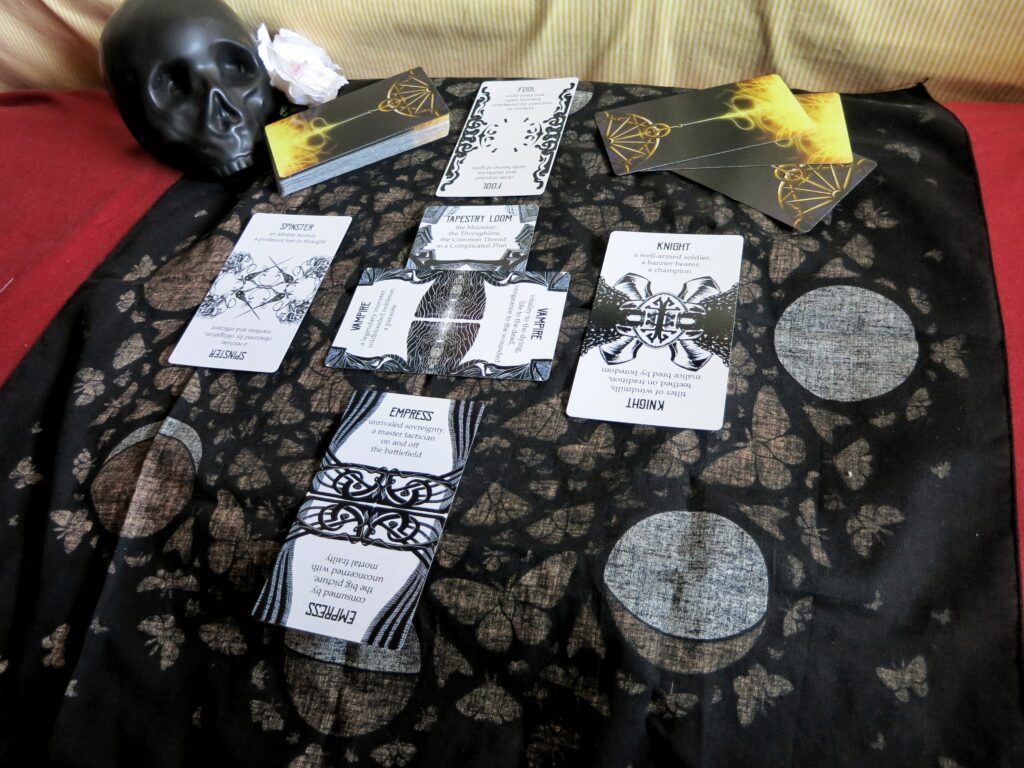
It should be no surprise that one of the most freeform formats of gamified storytelling – tabletop roleplaying games – would be so rife with supplemental material to fuel imagination right in the middle of a session. There are infinite single-sentence quest prompts for Dungeons & Dragons competing to spark ideas across endless tiles of Pinterest results, of course, but there are also entire games that run on standalone tables and generators. And then, there is the inscrutable Tarot deck.
Game designers like Sasha Reneau pick it up knowing full well that this small stack is an endlessly reimagined list of the same set of symbols. It carries meaning in every part of its art, its associated suit, and even in the act of holding it upside down. They know that even on its own, it can be used to manifest and develop an engaging story. (And, if you have ever seen people read Tarot cards, you know how much importance such a story can carry.)
It’s not easy to iterate on an object this iconic, but Sasha Reneau recognized that a lot of meaning can emerge simply by assigning a specific role to a symbol: is it an Event? A Character? Is it their Method? Their heart’s Desire? With concepts so flexible in their interpretation, the human brain can go wild manifesting them, spotting a very specific feeling amidst the noise of their own knowledge of the universe and chasing it down as it sparks more and more ideas, until a unique place in a narrative suddenly emerges. That, of course, is when the true magic happens.
A Starting Point, Single Card: Overcoming the Fear of Discovery
Your first reaction to the abstract prompts might be an uncomfortable jolt of apprehension. You might not even know much about reading Tarot spreads, but even if you do, all the example diagrams with different functional labels for every card can make it feel like there’s some elusive set of practices for a narrative deck of this kind.
On top of that, there are cards played onto other cards, player hands, reference cards, and different decks accumulated at the table… all of it might make it seem like Spindlewheel is for someone else, someone with a deeper degree of technical understanding of roleplay.
In this section, I would like to challenge this assumption. In fact, I think Spindlewheel’s true power remains in the creative simplicity at its core. So, take a couple of breaths, tune out that apprehensive white static of anxiety we cling to throughout our day, and join me in making this quiet little discovery.
Let’s take a single card out of the deck.
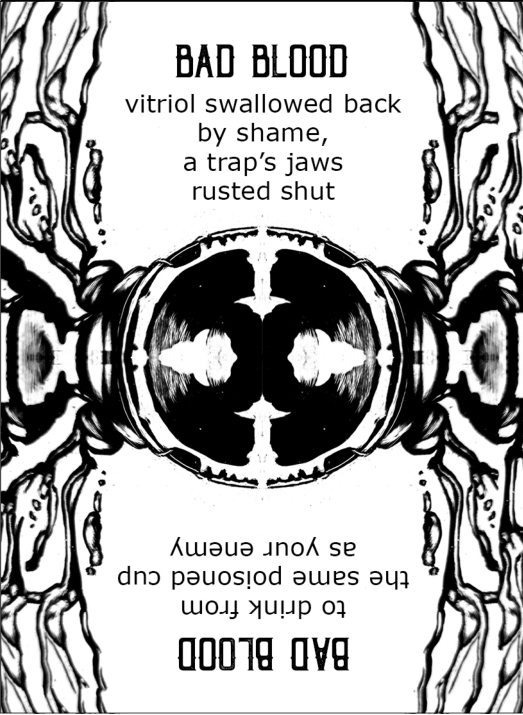
Bad Blood. Vitriol swallowed back by shame, a trap’s jaws rusted shut. Take just a second, don’t let me hand you the answer. Study the art on the card, latch onto any words that seem interesting. What feeling does it elicit?
Now, and here is where the deck draws its ability to tell stories: imagine someone represented by this card. The intention here is to think of a character, but the card could have spoken to you on such a personal level that it might have reminded you of someone you know, or some deeper part of you. You can reflect on that as well. What does this tell us about them?
It could be about trauma and hiding pain. Maybe it’s an old, dangerous trap. Perhaps it’s the bitterness of aggression that causes hurt.
Perhaps it’s about trauma, hiding pain behind shame. Maybe it’s a sleeping dragon, a vicious trap dulled with time. Maybe it’s the bitter taste of aggression that hurts one back.
The longer you sit with this card, the more material you attract toward yourself. If you drop the requirement for it to be something “good” or “correct” and let it flow as you would in a dream, playful and vivid connections begin to form.
Now, hold your impressions of the card for a moment, because I am about to complicate things a little bit.
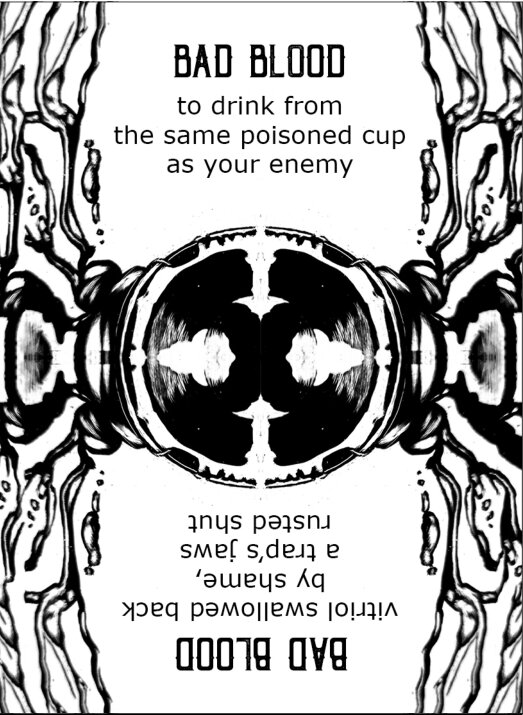
Yes, indeed: I just flipped the same card, introducing its inverse side.
Bad Blood. To drink from the same poisoned cup as your enemy.
Is this another character? Someone who feels a world away and yet is hinged upon another in their core essence? Is it the same person, but from the past? Does this represent their key moment from the future?
Regardless of where your mind went, you kept building upon your interpretation. Using the card to introduce a new bit of information might have spawned paths and taken you places you didn’t expect, giving shape to something that did not exist just a couple of minutes ago.
The good news is if you formed any ideas from this little exercise, you just played a little bit of Spindlewheel. Just with a single card and all by yourself. Imagine the endless interpretations and inspirations that can be sparked by the rest of the deck, and the spreading web of narratives that can be woven with a group of friends gathered together around a table (physical or virtual alike).
Giving Shape to the Imagination: The Genius of Spindlewheel
With the previous exercise, I hope we have transformed the rest of the structure from something that felt like a barrier to entry into an intriguing framework for expanding on the ideas.
Our little exercise focused on what the traditional Spindlewheel experience labels as the “Core” of the character (though, unlike in my dramatic presentation, the game invites you to choose between the upright and the inverse interpretations every time you do an interpretation).
However, the “who” is but one aspect of a character, and Sasha invites us to draw from the deck to uncover further detail. Both the characters and the world are fleshed out using a slightly modified version of a classic Tarot 10-card spread:
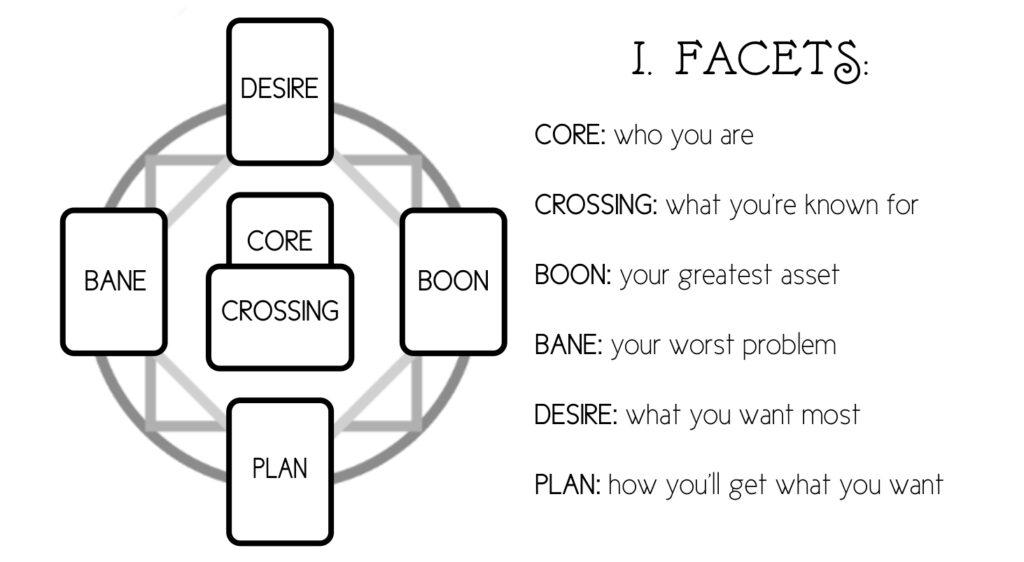
Each player begins by interpreting their own spread, as well as one for the world where the “Core” is understood as “the heart of the situation”. Completing each spread are three cards that evaluate the past, the present, and the potential future. Then, the players spend the rest of the game following events while trying to obtain their desires and resolve the potential future of their characters.
In essence, this is where the vivid idea sparks from the deck become transformed into proper structured stories. Unlike Tarot and similarly unstructured inspiration decks, Spindlewheel offers a few critical ways to drive the narrative momentum and introduce tangible changes into the story.
Notably, many of the cards in play do not get discarded. The original spreads for player characters become player hands, and the world spread becomes a deck of known facts, the Arbiter. Players can exchange cards with each other and the Arbiter deck when they declare a bond or a connection, and anything that “[you] haven’t seen the last of” is added to the Arbiter. So, introduced facts get reflected in what is available in play.
One Deck, Endless Applications: Microgames and Expansions
However, Sasha’s offerings do not stop here. The wealth of alternative scenarios for the deck is available in Indiepocalypse Issue #36 as “Spindlewheel Microgames”. Here, four engaging scenarios invite you to see a crime scene through to its end, meet other lost souls in a train riding through the afterlife, face off against someone you once knew but can no longer coexist with, or undertake a mountain-scaling pilgrimage where re-ordering the cards forms the route.
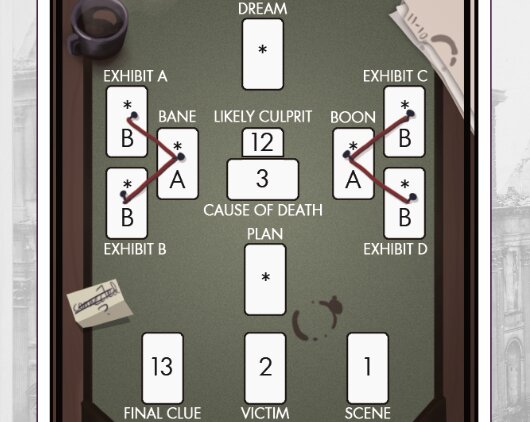
The community has offered its own card expansion packs and microgames over the years, and a deck like this can be a unique addition to drive worldbuilding before or even during a traditional TTRPG session. You are unlikely to ever run out of applications.
If you have never experienced giving up some control in generating a story, trusting your imagination to make evocative connections in the moment, I implore you to experience it. Such interpretive play is enlightening in its humanity: people at the table are the ones to supply the meaning, while sharing unguarded fragments of themselves – their fears and desires – to contribute to the living tapestry taking shape at the center of the table.
Sasha’s Spindlewheel, the deck designed to elicit dynamic, interconnected ideas, and guide them into their place in the story, might just be one of the best tools available for this.