Eider Cake: impossible lives & possible worlds
By Lucas Souza
In Indiepocalypse #53, I played Eider Cake, a short but charming visual novel about an abbey managed by talking birds. However, I didn’t understand why that game fascinated me so much until I got to know the other works of its artist, sweetfish. I soon realized that there was a strange harmony between their craft and thoughts that I have about the relationship between fiction and reality. But first, a small detour into a real tragedy.
A ship with 588 people on board sank, and today it is estimated that more than 1.000 died. How did it happen? It was 1916, the ship was the “Príncipe de Astúrias” and, even though the number of passengers was less than six hundred, hundreds more were hidden in the ship’s hold in an attempt to flee from World War I. Dead as stowaways, without records, without memory, without wailing.
A tale as old as time: history is gentle with a few and, in each age, crushes so many others. As any form of remembrance is absent, any attempt to represent these lives becomes almost impossible and all that remains is to use the contours left by these people as footprints to imagine a possible world. Doing archaeology where it shouldn’t be necessary.
Today, we have the ability to produce and retain a lot of information in its entirety, even though this doesn’t happen. But this potential is an opportunity to go beyond: is information alone enough to safeguard memory? After all, information is only an index to the real experience.
In philosophy of mind, there’s talk about qualia, a word that represents the difference between physical knowledge and subjective experience, postulating an unbridgeable gap dividing these two realms. In a related manner, transmitting the same subjective experience is impossible, even if the sender and receiver are the same person separated by mere seconds in time.
The question, then, is whether subjective experience can be transformed into an object capable of carrying certain particularities that would otherwise remain inaccessible. In other words, it isn’t the desire for a complete recreation of reality imagined by nineteenth-century men, as André Bazin describes in his essay “The Myth of Total Cinema,” but rather an arrangement of elements from reality designed to produce a specific aesthetic effect. Sweetfish has a great eye for that.
With a varying diversity of free games published, sweetfish describes themselves as an “interactive fiction hobbyist & thing-maker”, and the latter part is essential because their body of work blurs the boundaries expected from a video game, yet each one expresses interesting ideas about the relation between reality, fiction, and memory.
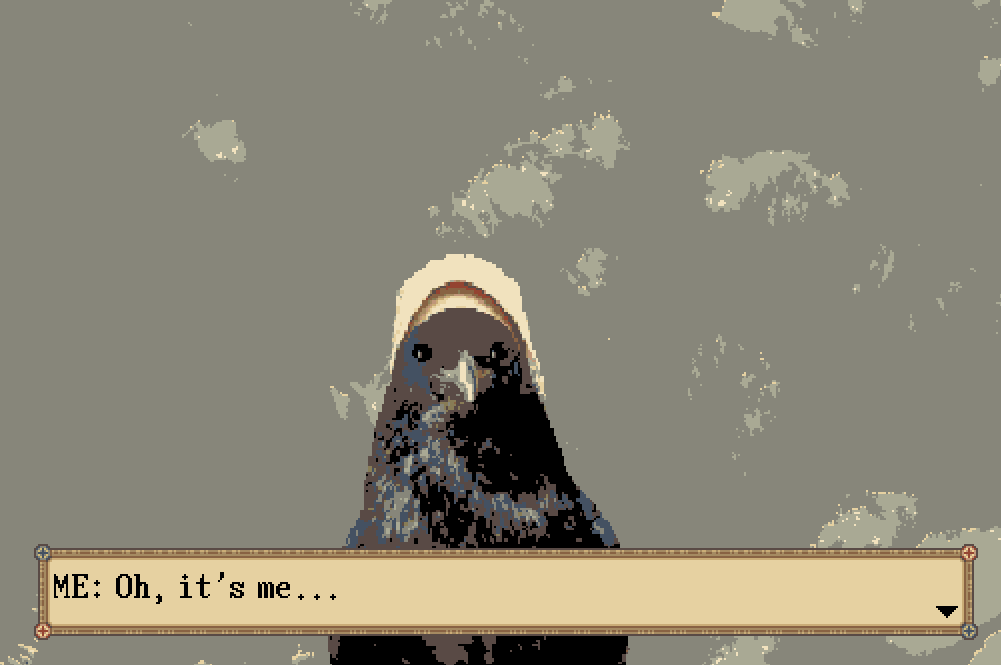
Eider Cake is more timid about it, but it connects to the historical invisibility that struck the stowaways from the “Principe de Asturias”. The game’s story takes place in a medieval abbey, but the main character isn’t a nun—or human. She is a lay sister, a role reserved for women of poor origins, typically illiterate, who used to do the manual labor that made possible the continuity of the nuns’ religious and intellectual works. And, amid lay sisters, the protagonist is only a scullion girl, the bottom of the abbey’s hierarchy.
It’s Saint Eider’s Day, patron of the abbey, and a great feast is to happen, with the illustrious visit from a delegate, but the kitchener lost the recipe book and wants you, the scullion girl, to search for it. With this premise, sweetfish sees the opportunity to imagine how it would be to be that person—or, in that case, this bird—roaming the corridors of the abbey. Which environments would you visit? Which sounds would you hear? Who would you encounter? How would it be to the invisible heroine of the feast? Would there be glory?
Eider Cake starts in the middle of a noisy kitchen working at full throttle, but it is quickly replaced by the silence of the abbey’s corridors as we start our search for the manuscript. Alone with the sound of her own footsteps, the protagonist wanders aimlessly to the library, refectory, necessarium, infirmary, chapel, scriptorium, belfry, gardens and, along the way, finds many books that, of course, she can’t read but knows aren’t the books that she needs. Until she finds it by the lake.
But there’s no need to return it right away, because a significant portion of Eider Cake is about exploring the environment and chattering through it. This world is a parody of Catholic tradition. You’ll encounter figures who live at the abbey and ask them in the hope that it gives you information about the lost manuscript; only to discover more about that alternative world where birds committed the original sin.
While researching these nuances, I found out a curious coincidence: Saint Eider, the fictitious patron of this world—after all, eiders are ducks—is an alternative version of Saint Sebastian, martyr who was sentenced to death by arrows because of his Christian faith but survived and, after that, was killed by soldiers. But Saint Sebastian is also the saint that gives his name to the archipelago where the “Principe de Astúrias” shipwreck happened. It has no special meaning, but it is fascinating when something leads you to another and then, somehow, brings you back to the beginning.
That made me linger on Saint Sebastian’s image and his history, especially the circumstances of his martyrdom, because, even though he really existed and suffered persecution, the dramatic core of his execution could be completely fictional. It could be an existence as real as the little bird that saved the feast by finding a recipe book.
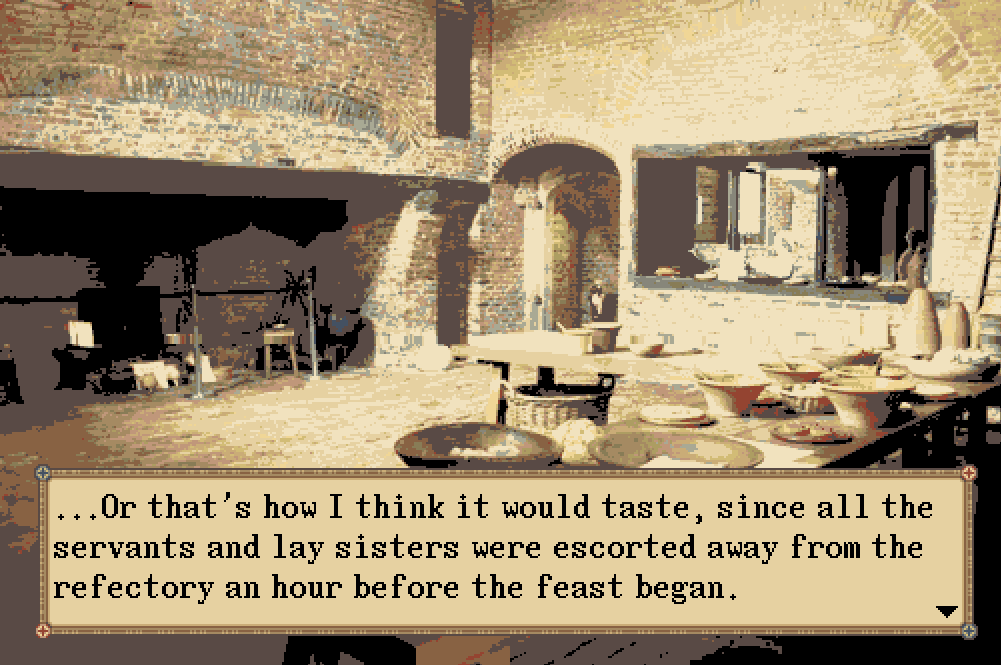
Her reward, however, was smaller than centuries of devotion. The ending starts with an illustrated narration from the protagonist about all the food scattered alongside the pompous feast’s table, just to reveal that it was all merely the reveries of the scullion girl. Like all the other lay sisters, she ate the same leftovers, the feast living only in her imagination. Her real reward was a small cake slice that the kitchener secretly set aside to give as a gift to her assistant.
Sweetfish’s interest in this character manifests many characteristics of their work. As a “thing-maker”, the artist explores the frontiers between reality and fiction; the retelling of stories; and the preservation of human expression put in the context of the contemporary world where the internet’s existence is inescapable, showing how games can be anything.
Their “interactive fictions” also shine, such as the excellent Night Confessional, which uses the Catholic faith, but in an imagined world where special telephone booths are used to do the sacrament of confession remotely for the price of a coin. Besides this, Eurydice Exhumed is an unique retelling of the Orpheus Myth, and GONCHAROV 2073 is an interesting commentary on AI and technology using as base a non-existent Martin Scorsese movie.
There are also the “things”—that I just call games—referred to as “visual experiences” that directly approach the notion of transformation of subjective experiences into objects that can produce certain aesthetic effects by selecting elements of reality. My personal recommendation is blaring rooms, composed of a collection of pixelated photos and their everyday sounds recorded by the artist. In the description, it is mentioned that one of these places was demolished shortly after the recording, which makes everything considerably more contemplative.
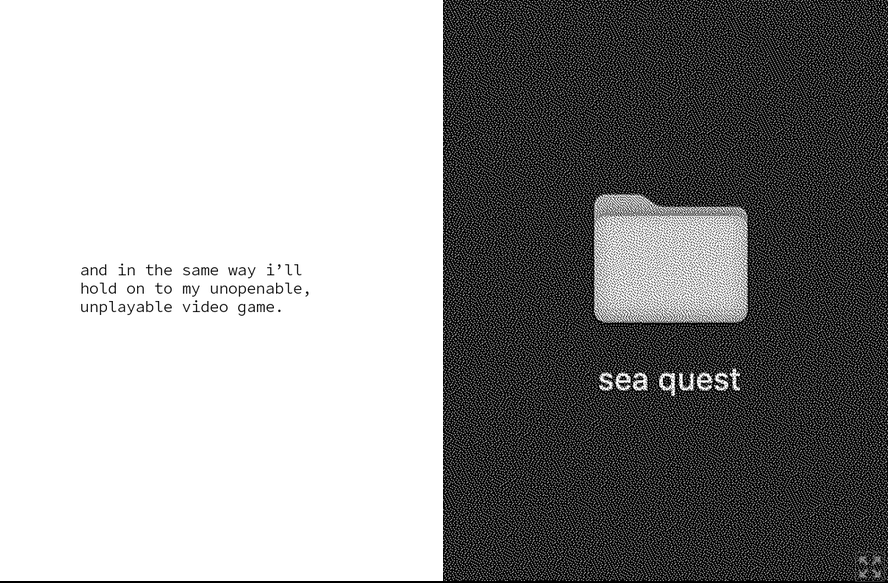
Lastly, what made this text exist: a zine called i will not delete my games that tells the story of how sweetfish’s first game was made unplayable, recalls all the games that they deleted by their own choice, and makes a promise to never do this again. A work filled with emotion that affected me deeply and made me put sweetfish’s characteristics that bewitched me into perspective. This is what provoked the reflection that you, today, read as a text, but that was once just an amorphous feeling in search of expression.